The Eagle
The former mixed martial arts fighter, small-business owner, and now United States senator, Markwayne Mullin, commanded the Senate floor. Sitting across the hall sat Sean O’Brien, the head of America’s largest union, the Teamsters Union. The two were not friends; O’Brien was a gritty negotiator who had called Mullin a moron and accused him of being “a greedy CEO who pretends like he’s self-made.” In contrast, Mullin was known for his disdain for unions and for confronting them, which intimidated his employees.
The discussion on the Senate floor centred around the growing gap between the rich and the poor and how it affects the average American working family. However, Mullin was preoccupied with the insults directed at him and felt it was time to confront O’Brien.
“Sir, this is a time, this is a place. You want to run your mouth, we can be two consenting adults, we can finish it here,” Mullin said.
“OK, that’s fine. Perfect,” O’Brien retorted.
“You want to do it now?” Mullin challenged. “Stand your butt up then.”
“You stand your butt up,” O’Brien countered, prompting Mullin to rise from his chair as if ready to fight.
Bernie Sanders, the session chair, yelled at Mullin to sit down, banging his gavel repeatedly. “Hold it. No, no, no, sit down. Sit down! You’re a United States senator; sit down. This is a hearing, and God knows the American people have enough contempt for Congress—let’s not make it worse.”
Despite Sanders’s interruption, O’Brien responded, “You challenged me to a cage match, acting like a twelve-year-old schoolyard bully.”
Insults continued to be cast back and forth until the next senator felt compelled to start her questioning by talking over them.1
Although Mullin and O’Brien had conflicting worldviews, their real issue lay deeper. Mullin felt that his manhood had been insulted; his identity was at stake. What could he do but defend himself? Adopting the mentality of the pack dog, Mullin reacted, and O’Brien eagerly responded in kind. To Mullin, disrespect is a crime, particularly when directed at him; the offender deserves judgment and punishment. Their behaviour echoed the rules of the animal kingdom. As Mullin stated, “That’s how we are in Oklahoma.” Such conduct is what is expected of men.
If Mullin had possessed the deep sense of security typically associated with a U.S. Senator, as Sanders pointed out, he wouldn’t have felt the need to respond with such primal instincts. Whether this was an act of maturity or unprofessionalism is debatable, but clearly, O’Brien got under his skin. Mullin’s inner ‘He-Man’ was triggered, and O’Brien felt compelled to retaliate against accusations of being a self-serving racketeer. That’s what ‘He-men’ do when challenged.
The Illusion of an Eagle
I most often encounter my inner ‘He-Man’ in traffic. Hiding inside a vehicle feels like a safe space where I can let that inner bravado flow. Having loud headers, a steady stream of cab lights, and massive wheels certainly helps. A vehicle like that demands respect and says, “Go ahead! Just try and accuse me of being an asshole!”
Once, a patient came in with his foot already in a cast, explaining it was due to an incident with his vehicle. He had been parked on the side of the road, unable to merge into the street because of a slow-moving stream of cars. Eventually, he decided to jump out and stop the traffic so his friend could get the car out.
The vehicle he happened to stop was a classic ‘He-Man’-type large 4×4 pickup driven by a classic ‘He-Man’ driver. As expected, the driver became inappropriately upset and showed him the finger. He then sped forward and hit my patient while shouting out the window as he passed, “That’s how I deal with my problems!” Yet, just as he peeled his tires on the pavement, he was forced to stop again due to the jammed traffic. The ‘He-Man’ driver was stuck there awkwardly as other people emerged from their vehicles to assist my injured patient.
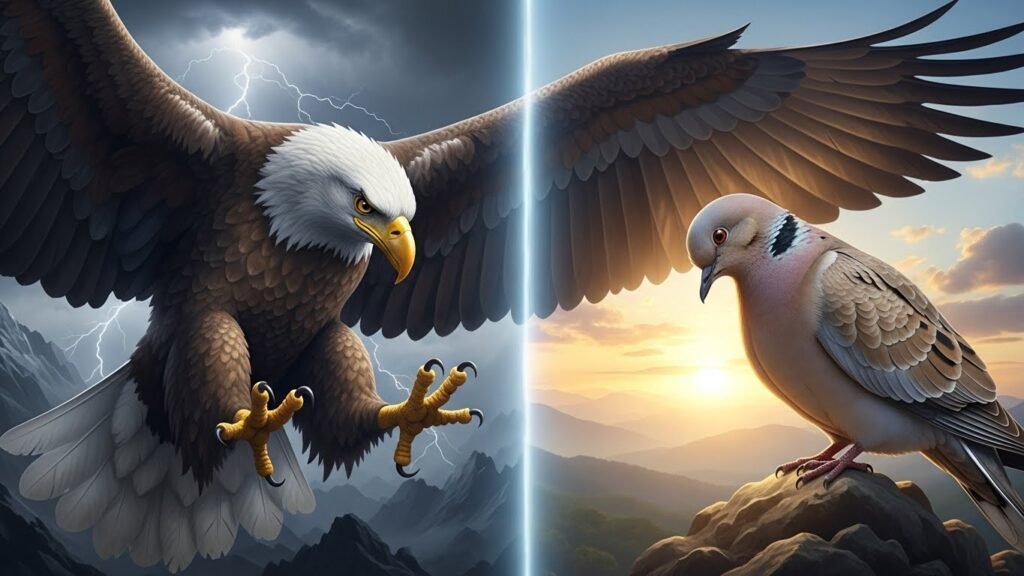
When I think of a ‘He-Man,’ I picture a creature of power, like a lion or an eagle. I can easily imagine an eagle behind the wheel of that 4×4 showcasing its dominance. The Romans had good reason to choose an eagle as a symbol of power and control. As a countryman, it would have been seriously intimidating to watch men marching through my land with eagle-adorned staffs, much like the grand 4×4 truck flaunting itself on the road.
Consider the Bald Eagle. It is undoubtedly a majestic bird. How can you help but feel the courage emanating from its feathers as it soars through the sky with its wings spread wide? It glides high above for hours and hours, patiently waiting for the right moment while casting an intimidating shadow over the creatures below. For the early 18th-century founders of a new nation, what could be a better symbol of freedom and sovereignty? A Bald Eagle would become a lasting emblem for one of the world’s toughest and most powerful countries.
However, at least one founding father of America disagreed—Benjamin Franklin. He once wrote, “For my own part, I wish the Bald Eagle had not been chosen the representative of our country. He is a bird of bad moral character. He does not get his living honestly. You may have seen him perched on some dead tree near the river, where, too lazy to fish for himself, he watches the labour of the Fishing Hawk; and when that diligent bird has at length taken a fish, and is bearing it to his nest for the support of his mate and young ones, the Bald Eagle pursues him and takes it from him…” Not exactly the magnificent image an eagle is supposed to portray.
Franklin goes on, “The little King Bird, not bigger than a Sparrow, attacks [the Bald Eagle] boldly and drives him out of the district…the Turkey is in comparison a much more respectable bird, and withal a true original native of America… He is, besides, though a little vain & silly, a bird of courage, and would not hesitate to attack a grenadier of the British Guards who should presume to invade his farm yard with a red coat on.”2
There is something intrinsic to human nature that drives our craving for power—the desire to dominate others or to rise above them. We savour this pursuit, and without systemic checks and balances to hold us accountable, we readily abuse it. We come by this behaviour honestly; it’s ubiquitous throughout the animal kingdom.
It is no wonder that most countries look to the animal kingdom for a symbol that represents them, like eagles or lions. For example, Britain chose a lion, even though there are no lions in Britain. Scotland adopted a unicorn, while Wales chose a dragon. It begs the question: are there not enough magnificent or imposing creatures on the British Isles to represent them? Why not choose a dove? Grenada chose a dove as its national symbol, but that’s only because the Grenada Dove is unique to the country and endangered. No one opts for a dove as a symbol unless it is unique or endangered.
The Strength of a Dove
After Jesus was baptized, he emerged from the water. At that moment, heaven opened, and he saw the Spirit of God descending like a dove and resting on him. A voice from heaven declared, “This is my Son, whom I love; with him I am well pleased.”3 Why a dove? Why not choose an eagle to descend upon him? After all, that’s what Caesar Augustus would have demanded. A dove is akin to the humble donkey that Jesus rides on into Jerusalem through the Golden Gate. The Romans and their eagles wouldn’t have dared to embrace such humility. This theme recurs throughout the Gospels—seemingly powerless symbols like donkeys, lambs, or doves.
Today, a dove symbolizes peace. Is it because peace is weak and powerless? After all, a dove doesn’t embody the authority to rule as an eagle does. But here’s the thing: peace doesn’t require the right to rule. Confident honesty is its superpower. Peace compels us to get hold of ourselves and confront reality. Turns out, we aren’t gods, nor are we superior to anyone. Flaunting our right to rule and dominating others is an illusion that inevitably leads to pain and suffering. The illusion of ‘I’m-better-than-you’ is a regression into the animal kingdom from whence we came. It is a disingenuous mindset that results in conflict; the opposite of peace. To embrace peace is to embrace humanity as it should be.
The Roman Caesars put on a grand spectacle. The power of the sword entitled them to be considered ‘sons of the gods.’ Yet here, Jesus is identified as the singular son of God by a seemingly powerless bird. The Gospel writers force us to think upside down. The son of God is a dove, not an eagle. The real power is in peace, not the sword.
How does this play out in real life? As an observer of current events, I see story after story of nations repeatedly proclaiming themselves as eagles. Almost every time, this ends in pain and suffering for the victims. Where are the stories of power entities embracing the dove? Those willing to endure suffering, or even sacrifice their lives, for the sake of peace? Eagles seem devoid of this courage. They claim to have no weakness, but they project a self-serving illusion. It is the dove that is a truly mighty animal. It holds no illusions. It possesses the fearless determination and sacrifice required to tap into the power of peace.
Perhaps we have limited control over the forces that govern us. The arena we play in is much smaller. However, we are indeed the drivers of our own behaviour and possess influence in the communities we live in. I confess that I prefer strutting around, emanating the image of an eagle. But what is the endgame? To be a god? I need to check myself. Am I serious!? I know this path leads to pain and disharmony, yet my animal instincts drive me. Taking on the image of a dove is not a natural choice.
The Dove
Let’s return to the Senate floor and envision it differently. Recall Mullin, the former mixed martial arts fighter, small plumbing business owner, union hater, and now United States senator, who commands attention on the floor. Across the hall sits O’Brien, the head of the Teamsters Union, who has called Mullin a moron and posted insults about him on social media.
Mullin struggles to focus on the pressing issue at hand: the growing gap between the rich and the poor. The insults directed at him weigh heavily, and he feels it’s time to confront O’Brien. Acknowledging that he is reacting emotionally, he checks himself. His urge to give in to his primal instincts is strong, but he resists.
Mullin reflects, “I so desire to be an eagle here. I have every right to do so. After all, that’s how we do it in Oklahoma, and I have a reputation to uphold. But what’s the end game? Disharmony? Pain? More strikes? Wasted time? Flaring tempers? While I don’t like it, I choose instead to be a dove. Not for my own benefit; I know it’ll cost me. But in the long run, I do it for the good of others.”
Speaking to O’Brien, Mullin responds, “Sir, this may not be the time or the place, but we need to talk. I can see your frustration with big business, and I have my concerns about unions. We can be two reasonable adults and work this out.”
“OK, that’s fine. Perfect,” O’Brien replies with a sarcastic tone.
“Come on! What’s stopping us?” Mullin challenges. “Let’s get it done.”
“You get it done,” O’Brien quips, prompting Mullin to stand up from his chair and show his frustration. He takes a moment, settles down, raises his hands as if to coincide, and then calmly opens his hands in a motion of conciliation, as if to say, “I’m ready and willing to negotiate. I await your response.”
Sanders, the session chair, quickly intervenes, encouraging Mullin to sit down. “I appreciate the sentiment. You’re acting like a United States senator. I don’t want to discourage that. But we have a hearing to get through. God knows the American people need a working Congress.”
O’Brien responds anyway, “Alright, Mr Mullin. You have challenged me like a true senator, and I will respond in kind.”
The insults cease, peace descends, and the next senator can start her questioning in an orderly manner.
Questions for Reflection
Are there situations where eagle-like traits are necessary or even virtuous?
Is choosing the way of the dove realistic in high-stakes adversarial situations?
What would it look like for leaders to embrace the dove over the eagle in policy and action?
What steps can I take to recognize and resist my own ‘He-Man’ instincts in my daily life?
References