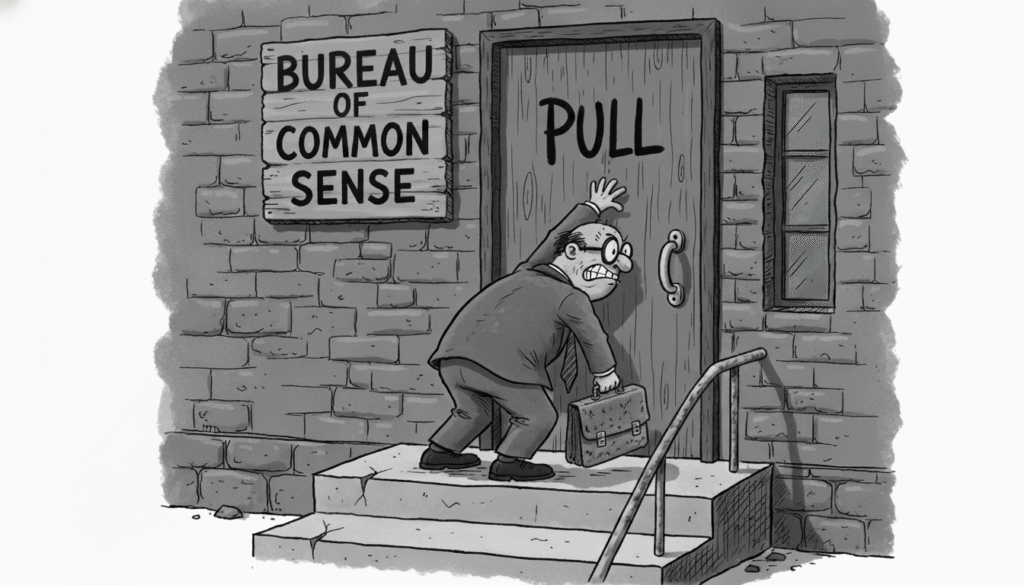
Seems obvious.
In February 2024, the American Supreme Court convened to deliberate a pressing question: the status of bump stocks. A bump stock is an attachment that gives ordinary firearms rapid-fire capabilities, leading some to equate them as deadly as machine guns. The crux of the issue lies in the distinction between the two; while machine guns can be banned, bump stocks are untouchable due to their different trigger mechanism. As such, the machine gun ban does not apply.
Michael Kosta, a commentator from The Daily Show, humorously asserted, 1
“I’m not a machine gun expert, but if a gun makes you go …oda oda oda oda oda oda oda oda oda oda oda…[shaking body violently] That’s a machine gun. I like to approach this case with my new legal theory. It’s called looking at something with your f***ing eyes. For instance, if a gun can fire 5000 rounds a second, you can debate firing mechanisms or you can look with your f***ing eyes and see that it's a machine gun.”
I’m totally aligned with Team Kosta. After all, the rationale of banning machine guns revolves around the sheer volume of bullets unleashed in a brief span. Consider the tragic Las Vegas music festival massacre in 2017, where a shooter fired an astronomical 1100 rounds in just 11 minutes from a hotel room using a converted firearm with a bump stock. Following this horrific event, the use of machine guns was rightly prohibited. Whether it was a bump stock or not should be irrelevant. Isn’t this simply a matter of common sense?
Kosta goes on to say,
“And this doesn’t just stop with guns. My legal theory can be applied to all sorts of issues, like IVF. You can debate viability or conception or you can just look with your f***ing eyes and see if this is a cluster of cells in a petri dish - not a person, OK?!. Do I need to take this petri dish to the playground and give it snacks all day? No?! Then it’s not a person. I’ve seen sourdough starters more alive than that.”
Maybe it isn’t so obvious.
Is it also common sense to assume that a cluster of cells in a petri dish is not a person? Can such a complex and nuanced issue as personhood truly be addressed in such simplistic terms? The notion of “common sense” suggests that something is self-evident, yet the debate surrounding abortion is anything but straightforward. It appears that strong emotions are clouding judgment and complicating the discussion. To assert that one’s perspective on abortion is based on common sense may inadvertently dismiss the validity of opposing viewpoints, which often arise from deeply held beliefs and personal experiences.
Suddenly it hits me: am I, in the same way, emotionally committed to being against guns? The mere fact that not everyone aligns with my perspective should prompt me to reflect deeply. The issue surrounding firearms is not as straightforward as I may have once believed; its complexities are layered and nuanced, each facet deserving of consideration. After all, when did I ever receive the definitive guide to solving the myriad dilemmas of life? It strikes me that I have no right to diminish someone else’s viewpoint on guns simply by proclaiming it as “common sense.” Not only that, but my common sense is based on the most elementary of my senses—nothing but my f***ing eyes.
But common sense simplifies things.
During the COVID-19 pandemic, I frequently encountered individuals espousing common-sense arguments to support unfounded conspiracies and denouncing government actions, vaccines, and established science. Working in the emergency department, I had to deal with patients who clung to their notions of common sense. They would proclaim, “Don’t complicate it with your science! Use your common sense!” Flat Earthers claim to rely on common sense, positing Kosta’s words, “Look with your f***ing eyes. The earth is flat.” And truth be told, it does appear flat from where I stand.
I find solace in embracing common sense. The idea of a flat earth is comforting; life would be much simpler if everything were easily understood. Why probe any deeper than the grains of sand that I see? Why look for anything larger than the dark canvas that envelopes the night sky at night, dotted with glowing pin holes we call stars? No need to investigate. Nothing to discover. There is nothing of interest beyond what I can see.
I shouldn’t resort to common sense so quickly.
But can I truly find lasting contentment in such simplicity? If we could know and understand everything with a mere glance, the thrill of discovery would quickly evaporate. Humans, by nature, thrive on unravelling mysteries. We are captivated by the intricate layers of existence that beckon exploration. The very complexity of our world ignites a sense of wonder—it is precisely what makes life worth living.
In the end, I’ve been reminded to put on the brakes before resorting to claims of common sense. By exclaiming, “Just look with your f***ing eyes!”, I dismiss others with differing views as senseless, overlooking the myriad complexities that shape their opinions and risking the opportunity for personal growth through newfound knowledge. Perhaps I might even learn something valuable, even if my conclusions differ.
No, I will hold back my emotions, avoid hastily claiming common sense and engage in open dialogue. I will pose the questions, “How and why did you arrive at your point of view?” and acknowledge that neither of us holds the exclusive claim to common sense. Yet I have faith that both of us have some sort of sense. Let us embark on a journey of discovery, unpacking the issue together. After all, it is the rich tapestry of perspectives and complexities that makes life exciting. It’s only common sense.
Questions for Reflections:
- Are there situations where common sense is more practical, and even necessary, in decision-making and where pausing to consider alternative perspectives might get in the way?
- Is instinctive decision-making valid, and is it the same as common sense?
- How can we balance respecting other viewpoints with the conviction that these different viewpoints may be harmful or factually incorrect?
- What steps can we take to move beyond our own bias and engage in open dialogue?
- Are there examples where common sense led to social change? Are there examples where common sense oversimplified a situation?